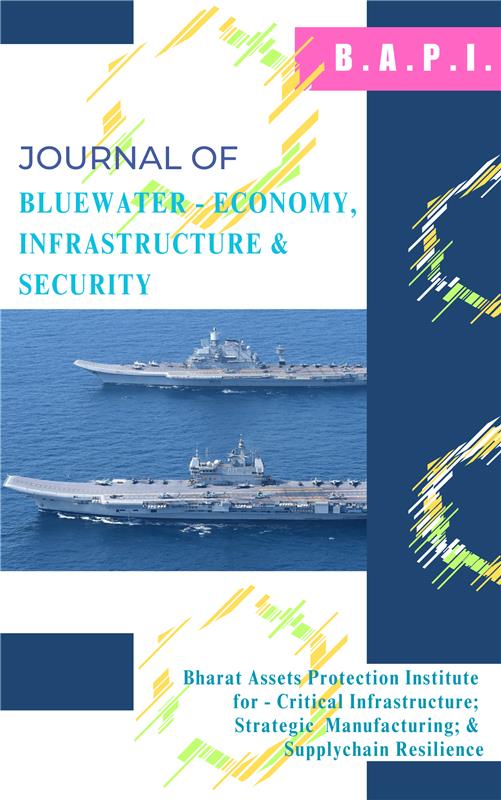
JCIIM welcomes original research articles, technical briefs, case
studies, and policy analyses. The journal upholds rigorous academic standards
and is committed to disseminating research that supports evidence-based
decision-making in infrastructure and manufacturing resilience.
India's cri...
JCIIM welcomes original research articles, technical briefs, case
studies, and policy analyses. The journal upholds rigorous academic standards
and is committed to disseminating research that supports evidence-based
decision-making in infrastructure and manufacturing resilience.
India's critical infrastructure, comprising sectors
like energy, transportation, telecommunications, and water management, forms
the backbone of its socio-economic progress and national security. Over the
past few decades, the interdependence of infrastructure sectors has become
increasingly evident, and so has their vulnerability to a range of threats,
including natural disasters, cyberattacks, and geopolitical tensions. As these
risks evolve, the need for a holistic approach to securing critical infrastructure
becomes paramount. Among the most effective strategies for safeguarding these
assets is the Public-Private Partnership (PPP) model, which combines the
strengths of both government and private sector capabilities. However, in its
current form, the traditional model of PPPs for infrastructure security often
falls short in addressing emerging challenges. This article critically examines
the need for redefining public-private partnerships in India to enhance
critical infrastructure protection (CIP), mapping the roles and stakes of key
stakeholders in this intricate ecosystem.
India's critical infrastructure, comprising sectors
like energy, transportation, telecommunications, and water management, forms
the backbone of its socio-economic progress and national security. Over the
past few decades, the interdependence of infrastructure sectors has become
increasingly evident, and so has their vulnerability to a range of threats,
including natural disasters, cyberattacks, and geopolitical tensions. As these
risks evolve, the need for a holistic approach to securing critical infrastructure
becomes paramount. Among the most effective strategies for safeguarding these
assets is the Public-Private Partnership (PPP) model, which combines the
strengths of both government and private sector capabilities. However, in its
current form, the traditional model of PPPs for infrastructure security often
falls short in addressing emerging challenges. This article critically examines
the need for redefining public-private partnerships in India to enhance
critical infrastructure protection (CIP), mapping the roles and stakes of key
stakeholders in this intricate ecosystem.
India's critical infrastructure, comprising sectors
like energy, transportation, telecommunications, and water management, forms
the backbone of its socio-economic progress and national security. Over the
past few decades, the interdependence of infrastructure sectors has become
increasingly evident, and so has their vulnerability to a range of threats,
including natural disasters, cyberattacks, and geopolitical tensions. As these
risks evolve, the need for a holistic approach to securing critical infrastructure
becomes paramount. Among the most effective strategies for safeguarding these
assets is the Public-Private Partnership (PPP) model, which combines the
strengths of both government and private sector capabilities. However, in its
current form, the traditional model of PPPs for infrastructure security often
falls short in addressing emerging challenges. This article critically examines
the need for redefining public-private partnerships in India to enhance
critical infrastructure protection (CIP), mapping the roles and stakes of key
stakeholders in this intricate ecosystem.
India's critical infrastructure, comprising sectors
like energy, transportation, telecommunications, and water management, forms
the backbone of its socio-economic progress and national security. Over the
past few decades, the interdependence of infrastructure sectors has become
increasingly evident, and so has their vulnerability to a range of threats,
including natural disasters, cyberattacks, and geopolitical tensions. As these
risks evolve, the need for a holistic approach to securing critical infrastructure
becomes paramount. Among the most effective strategies for safeguarding these
assets is the Public-Private Partnership (PPP) model, which combines the
strengths of both government and private sector capabilities. However, in its
current form, the traditional model of PPPs for infrastructure security often
falls short in addressing emerging challenges. This article critically examines
the need for redefining public-private partnerships in India to enhance
critical infrastructure protection (CIP), mapping the roles and stakes of key
stakeholders in this intricate ecosystem.