


Climate-Resilient Infrastructure
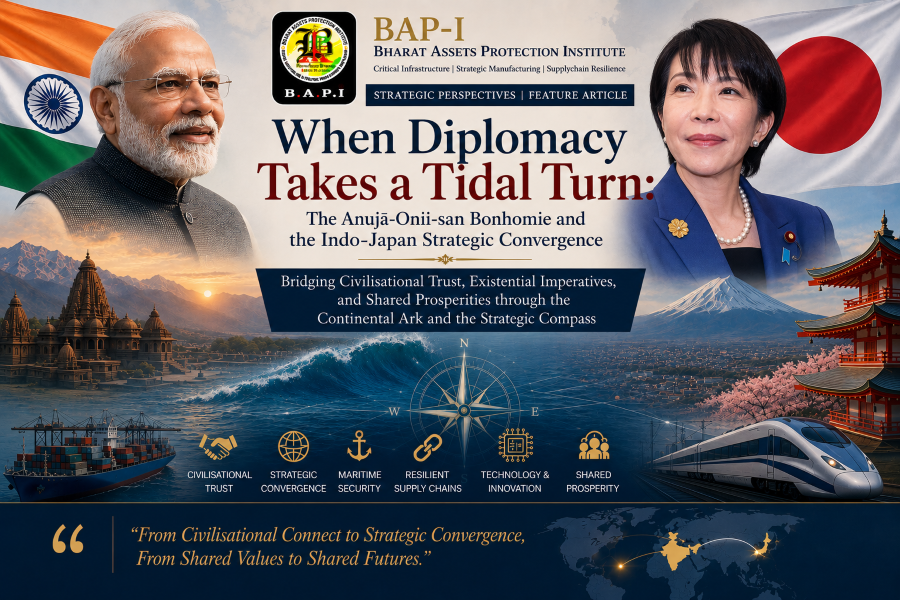
Abstract
|
|
The Sixteenth
India-Japan Annual Summit of July 2026 introduced the imagery of
civilisational bonhomie into contemporary statecraft when Prime Minister
Narendra Modi addressed Japanese Prime Minister Sanae Takaichi as his
“younger sister” and the relationship was reciprocally framed through the
vocabulary of an elder brother. This article argues that the Anujā-Onii-san Bonhomie
Diplomacy is not a symbolic gesture alone but a strategic multiplier that
accelerates convergence across security, economic resilience, critical
infrastructure, technology, maritime cooperation, and Indo-Pacific
governance. It proposes that Japan’s deepening
engagement with India is driven by two existential imperatives that operate
beneath the surface of summit declarations: capital continuity, arising from
an ageing, demographically declining economy whose accumulated savings and
industrial capital require a safe, growing, and trusted continental
destination for long-term preservation; and geographic insurance, arising
from an archipelago situated on the Ring of Fire, seismically and
volcanically exposed, climatically vulnerable to intensifying typhoons,
rising sea levels, and the spectre of territorial contraction, for which
India’s vast continental landmass, demographic dividend, and resource base
represent a civilisational insurance partner without parallel in the
Indo-Pacific. It is argued that these two imperatives together explain why
the India-Japan partnership is evolving beyond conventional bilateral
cooperation into a structural programme through which Japan’s critical
infrastructure ecosystems, strategic manufacturing ecosystems, and supply
chain ecosystems are being gradually transferred, preserved, banked,
partnered, and maintained with India through a mixed approach that ensures
their survival and operational continuity regardless of what the future holds
for the Japanese archipelago. The article examines this convergence across
five strategic domains and concludes that the partnership constitutes the
construction of a continental ark for Japan’s civilisational, industrial, and
technological inheritance. It concludes that India must accept what the ark
carries because it serves Bharat’s own industrial transformation; but the
compass of strategic autonomy must remain in Indian hands, for the freedom to
define its own Indo-Pacific choices is the one civilisational inheritance
that India cannot afford to entrust to anyone else. |
Keywords : India-Japan strategic convergence; Anujā-Onii-san Diplomacy; capital continuity; geographic insurance; continental ark; critical infrastructure; supply chain resilience; MAHASAGAR; FOIP; Indo-Pacific
I. Beyond Transactional Diplomacy:
Towards a Civilisational Partnership
International relations
have long been interpreted through the lenses of power, deterrence,
alliances, trade, and national interests. Classical diplomacy largely
evaluates bilateral relationships by the number of agreements signed, trade
volumes achieved, defence partnerships established, or geopolitical
objectives secured. While these remain indispensable indicators of interstate
relations, they seldom explain why some partnerships mature into enduring
strategic relationships while others remain largely transactional.
Increasingly, the most resilient partnerships are sustained by a deeper
foundation comprising historical memory, cultural affinity, shared values,
political confidence, institutional continuity, and trust between leaders.
The contemporary India-Japan relationship demonstrates this evolution with
remarkable clarity. The Sixteenth India-Japan
Annual Summit, held from 1 to 3 July 2026 during Japanese Prime Minister
Sanae Takaichi’s first official visit to India, illustrated this transition
in an unusually symbolic yet strategically meaningful manner. During the
joint press briefing at Hyderabad House on 2 July 2026, Prime Minister
Narendra Modi opened his address with the words: “Your Excellency, and meri
chhoti behen (my younger sister) Prime Minister Takaichi, delegates of the
two countries, members of the media, Namaskar! Konnichiwa” (Prime Minister’s
Office, 2026). Prime Minister Takaichi, who heard the simultaneous Japanese translation,
responded with a warm smile and subsequently acknowledged: “The small meeting
before and the big meeting … we confirmed that we are on the same page to
develop this relationship as brother and sister” (Ministry of External
Affairs, 2026). Although seemingly personal, this exchange carried
significance beyond diplomatic etiquette. It introduced a civilisational
vocabulary into modern statecraft, reflecting an Asian understanding of
relationships rooted in respect, responsibility, continuity, and mutual
confidence rather than merely contractual cooperation. This article proposes the
concept of Anujā-Onii-san Bonhomie
Diplomacy as a framework for understanding this evolution. The concept does
not suggest that personal warmth alone determines foreign policy. Rather, it
argues that leadership trust, when embedded within compatible strategic
interests and supported by strong institutions, can accelerate policy
implementation, strengthen public confidence, encourage long-term investment,
and reinforce comprehensive strategic partnerships. Personal rapport becomes
a strategic multiplier rather than a substitute for institutional diplomacy.
The Joint Statement issued during the 2026 summit explicitly reflects this
transformation by describing the bilateral relationship as a partnership
advancing “Strategic Convergence and Trust for Shared Growth, Prosperity and
Resilience” (Prime Minister’s Office, 2026). Yet the argument of this
article goes further than the conventional analysis of summit outcomes. It is
argued that beneath the diplomatic vocabulary, beneath the sixteen agreements
signed, beneath the joint declarations and press briefings, two existential
imperatives drive Japan towards India with an urgency that transcends any
single summit or any single leader. The first is capital continuity: Japan’s
ageing, demographically declining economy generates savings and industrial
capital that must find a safe, trusted, growing continental destination if
they are to retain their value across generations. The second is geographic
insurance: Japan’s archipelago, situated at the intersection of the Pacific
Plate, the Philippine Sea Plate, and the Eurasian Plate along the Ring of
Fire, is among the most seismically, volcanically, and climatically
vulnerable territories on earth; India’s vast continental landmass, its
demographic dividend, and its resource base represent a civilisational
insurance partner without parallel. These two imperatives, operating
together, explain why the India-Japan partnership is evolving from
conventional bilateral cooperation into something structurally unprecedented:
a programme through which Japan’s critical infrastructure ecosystems,
strategic manufacturing ecosystems, and supply chain ecosystems are being
gradually transferred, preserved, banked, partnered, and maintained with
India through a mixed approach that ensures their survival regardless of what
the future holds. Yet the argument carries a necessary caveat: India must
receive what is offered with sovereign discernment. The ark is valuable; but
India’s participation must be calibrated to ensure that what is banked on
Indian soil becomes Indian capability, not merely Japanese overflow, and that
the terms of the partnership serve Bharat’s national interest as much as they
serve Japan’s civilisational continuity. II. From Civilisational Trust to
Strategic Convergence
Diplomacy, regardless of
how richly it draws upon cultural memory or historical sentiment, ultimately
succeeds or fails by the policy outcomes it produces. Civilisational affinity
may create a favourable atmosphere between states; yet atmosphere without institutional
delivery remains ceremonial. It is argued that the true analytical
contribution of the Anujā-Onii-san Bonhomie
Diplomacy lies not in its symbolic warmth but in its capacity to reduce the
friction that ordinarily separates political intent from policy execution.
The progression through which this occurs may be articulated as follows:
civilisational affinity creates mutual recognition; mutual recognition
generates leadership trust; leadership trust produces political confidence
across bureaucratic, military, and commercial institutions; political
confidence reduces the diplomatic friction that accompanies negotiation,
ratification, and implementation; reduced friction accelerates strategic
convergence across multiple domains simultaneously; strategic convergence
solidifies into institutional cooperation; institutional cooperation
stabilises regional order; and a stabilised regional order enables shared
prosperity. The 2026 summit provides
empirical illustration. On 2 July 2026, at Hyderabad House in New Delhi,
Prime Ministers Modi and Takaichi signed sixteen agreements spanning defence
co-development, artificial intelligence, economic security, clean energy,
critical minerals, pharmaceuticals, battery manufacturing, mobility
partnerships, biotechnology, financial services, and internet governance
(Ministry of External Affairs, 2026). That these sixteen outcomes
materialised within a single summit is itself noteworthy; that they spanned
such a breadth of sectors points to a partnership in which trust has already
been converted into institutional architecture, and institutional
architecture is now generating operational cooperation at speed. The
bilateral framework now comprises over seventy dialogue mechanisms (Ministry
of External Affairs, 2026). The relationship between
India and Japan can no longer be contained within the conventional category
of bilateral diplomacy. The two countries have evolved into co-architects of
regional order. They function as co-developers of regional institutions through
their joint commitment to the Quad alongside the United States and Australia,
through ASEAN-centred mechanisms, through BIMSTEC, and through the
Indo-Pacific Oceans Initiative. They operate as co-providers of regional
public goods by offering infrastructure financing, maritime domain awareness,
humanitarian assistance, disaster relief, and capacity building to smaller
states across the Indian Ocean and the Pacific. They serve as co-investors in
resilience by jointly developing semiconductor supply chains, diversifying
critical mineral sourcing, strengthening energy security, and building
trusted digital networks. And they act as co-shapers of Indo-Pacific
governance by advocating for freedom of navigation, the peaceful settlement
of disputes, and the protection of open sea lines of communication. India’s
role as co-architect, however, must remain India’s own sovereign choice
rather than a position determined by another nation’s strategic design. The
distinction is consequential: a co-architect shapes the structure; a
participant merely occupies it. But the question that
conventional analysis fails to answer is why Japan invests in India with an
intensity and a breadth that exceeds what commercial logic alone would
dictate. The answer lies in the two existential imperatives.
III. The Two Existential
Imperatives: Capital Continuity and the Continental Ark
The First Imperative: Capital
Continuity
Japan is the world’s most
rapidly ageing major economy. Approximately thirty per cent of its population
is aged sixty-five or older; its fertility rate stands at approximately 1.3
births per woman; its population, having peaked at 128.1 million in 2008, is
projected to decline to approximately 96 million by 2060 and to below 70
million by 2100 under current trends (OECD, 2024; Nature, 2026). The OECD
projects that Japan’s population could fall by forty-five per cent by the end
of the century, with employment declining by fifty-two per cent. A 2020
global analysis found that Japan is among twenty-three countries that could
see a total population decline of fifty per cent or more by 2100. Japan’s
public debt, at approximately 246 per cent of GDP, is the highest in the
world. Social security expenditures consume more than one-third of the
national budget. The working-age population has been declining since the
mid-1990s. The IMF has predicted that the shrinking population will make GDP
growth exceedingly difficult, projecting an annual loss of 0.8 percentage
points over the coming decades (IMF, 2020). In this demographic
context, Japan’s accumulated capital, its savings, its industrial assets, its
technological intellectual property, its manufacturing know-how, and its
institutional expertise represent a civilisational inheritance that cannot be
sustained within an economy whose domestic market is contracting, whose
labour force is shrinking, and whose consumption base is eroding. Capital
must move outward to survive. But it cannot move to any destination; it must
move to a destination that is trusted, growing, demographically expanding,
institutionally stable, and strategically aligned. India satisfies every one
of these conditions. India’s population is young, its economy is among the
fastest-growing, its domestic market is expanding, its democratic institutions
are stable, and its strategic alignment with Japan is reinforced by shared
values, compatible geopolitical interests, and the civilisational trust that
the Anujā-Onii-san Bonhomie
embodies. This is why Japan set a target of ten trillion yen (approximately sixty-seven billion US dollars) in private-sector investment in India over the coming decade at the Fifteenth Annual Summit in Tokyo in August 2025, building upon the earlier five-trillion-yen target set in 2022 which was achieved in three years (Ministry of Foreign Affairs of Japan, 2025; Business Standard, 30 August 2025). This is why approximately 1,500 Japanese companies with nearly 5,000 business establishments operate in India. This is why India ranked first in JBIC’s 2025 survey as the most promising overseas investment destination for the fourth consecutive year, with 61.8 per cent of respondents identifying India as the preferred market (JBIC, 2025). This is why a JETRO survey found that 81.5 per cent of Japanese firms plan to expand their Indian operations (Outlook Business, 30 June 2026). Capital continuity is not philanthropy; it is survival. Japan’s money must remain safe for the long run, and India is the safest continental vault in the Indo-Pacific.
Figure 1: Japan’s
Existential Trajectory: As the Population Declines, Capital Flows to India
Rise (Author’s compilation) The Second Imperative: Geographic
Insurance and the Continental Ark
Japan’s second
existential imperative is geographic. The Japanese archipelago sits at the
intersection of several tectonic plates along the Pacific Ring of Fire, an
area where seismic activity, volcanic eruptions, and tsunamis are not
possibilities but certainties. Japan is home to over one hundred active
volcanoes, including Sakurajima, which erupts several hundred times annually.
Experts estimate a seventy per cent probability of a major earthquake
(magnitude 7 or higher) striking the southern Kanto area, including Tokyo,
within the next thirty years. The Nankai Trough, which runs along the Pacific
coast, poses a catastrophic earthquake and tsunami risk that Japanese
officials regard as a matter of when rather than whether. The 2011 Great East
Japan Earthquake and Tsunami, which killed nearly 20,000 people and triggered
the Fukushima nuclear disaster, demonstrated that even the world’s most
prepared society can be overwhelmed by the forces that its own geography
generates (Japan Times, 1 August 2025; Give2Asia, 2023). Climate change
intensifies these vulnerabilities. Typhoons are becoming more frequent and
more severe. Sea levels are rising. Extreme heat events are increasing.
Coastal communities, which include some of Japan’s most densely populated and
industrially significant zones, face growing inundation risk. A Nature study
published in 2026 projected that more than half of Japan’s geographic grids
may become uninhabited by 2100, with population concentrating in a narrowing
band around Tokyo (Nature, 2026). Japan is not merely ageing; it is
physically contracting. In this context, India
represents something that no other partner in the Indo-Pacific can offer: a
vast, geologically stable, continental landmass with a young and growing
population, an expanding industrial base, a democratic governance system, and
a civilisational affinity with Japan that reduces the trust deficit inherent
in transferring industrial and technological assets overseas. India is not
prone to the seismic, volcanic, and tsunami risks that define Japan’s
geography. India’s continental depth provides strategic insulation that an
island archipelago cannot possess. India’s demographic trajectory is the
mirror image of Japan’s: where Japan contracts, India expands; where Japan
ages, India rejuvenates; where Japan’s domestic market shrinks, India’s
market grows. It is argued that these
two imperatives, capital continuity and geographic insurance, operate
together as a single strategic logic. Japan’s critical infrastructure
ecosystems, its strategic manufacturing ecosystems, and its supply chain
ecosystems represent the accumulated civilisational achievement of a society
that has invested decades in building world-class industrial capability. If
these ecosystems remain entirely within the Japanese archipelago, they remain
vulnerable to the same seismic, volcanic, climatic, and demographic forces
that threaten the archipelago itself. But if they are gradually, through a
mixed approach of transfer, preservation, banking, partnering, and
maintenance, distributed across a trusted continental partner, then they
survive regardless of what happens. India becomes, in effect, a continental
ark for Japan’s civilisational and industrial inheritance: a place where
Japanese capital is safe, where Japanese technology is preserved, where
Japanese manufacturing know-how is reproduced and maintained, where Japanese
supply chains are replicated and diversified, and where the continuity of
Japan’s contribution to human civilisation is assured even if the archipelago
itself faces the worst that its geography and demography threaten. This is the structural logic that underlies the Anujā-Onii-san Bonhomie. The warmth is real; but the imperative is existential.
Figure 3: Geographic
Vulnerability versus Continental Depth (Author’s original schematic
visualisation)
IV. Critical Infrastructure as
Civilisational Insurance
The proposition that
infrastructure has become strategic, and that strategic infrastructure
constitutes national resilience, acquires particular force when examined
through the lens of the continental ark thesis. Japan’s infrastructure
engineering is among the most advanced in the world; its expertise in
high-speed rail, earthquake-resistant construction, precision manufacturing,
environmental management, disaster risk reduction, and smart city
technologies reflects decades of investment. When Japan transfers these
capabilities to India, it is not merely financing development; it is
replicating its civilisational infrastructure on continental ground. The Mumbai-Ahmedabad High
Speed Rail (MAHSR) project exemplifies this logic. Employing Japan’s
Shinkansen technology, the project requires the transfer and localisation of
advanced engineering capabilities including track design, tunnelling, bridge
construction, signalling systems, rolling stock manufacturing, safety
management, and maintenance protocols. The 2026 summit reaffirmed its
importance; Prime Minister Takaichi stated that “Japan fully understands
India’s target to commence commercial operations on priority sections in 2027
and remains committed to extending the necessary cooperation” (Prime
Minister’s Office, 2026). The two leaders expressed willingness to explore
cooperation on future high-speed corridors to achieve India’s vision of a
national high-speed rail network of seven thousand kilometres. Each corridor,
once established, creates industrial ecosystems, supply chains, technical
workforces, and institutional capabilities that are banked on Indian soil. The Next Generation
Mobility Partnership (NGMP) signed at the 2026 summit extends this logic
across railways, automotive, aviation, shipbuilding, logistics, ports, and
urban infrastructure, positioning India as a manufacturing hub for global
exports (Ministry of External Affairs, 2026). Japan’s metro rail cooperation
in Mumbai and Bengaluru, its investment in India’s North Eastern Region, and
its support for industrial corridors further distribute Japanese
infrastructure capability across India’s continental geography. The first
defence co-development project, the UNICORN (Unified Complex Radio Antenna,
also designated NORA-50) naval antenna system, represents the banking of
defence-industrial capability on Indian soil through co-development. Prime
Minister Modi stated: “Today, we have signed an agreement on the first
co-development project between India and Japan in the defence sector. This
project for a naval radio antenna will open a new chapter in our defence
technology partnership” (Prime Minister’s Office, 2026). Foreign Secretary
Misri confirmed that cooperation “could span the entire spectrum from
designing to production and manufacturing,” encompassing land, air, naval
systems, and unmanned vehicles (Misri, 2026). When viewed through the
continental ark thesis, each of these projects is a node in a distributed
resilience network. High-speed rail on Indian soil preserves Shinkansen
technology. Metro systems preserve urban transit engineering. Defence
co-development preserves naval electronics capability. The NGMP preserves
shipbuilding, aviation, and logistics know-how. Together, they constitute a
systematic programme of civilisational insurance. India’s interest in this
programme, however, is not passive reception. Under the Atmanirbhar Bharat
framework and the vision of Viksit Bharat 2047, every capability transferred
must be absorbed, indigenised, and made Indian in ownership, operation, and
strategic direction. The ark’s cargo must become Indian industrial capability;
otherwise the transfer merely relocates dependency rather than creating
sovereignty.
V. Supply Chain Resilience and the
Preservation Imperative
The India-Japan Joint
Declaration on Economic Security Cooperation, adopted at the 2026 summit,
identifies five priority sectors for project-based collaboration:
semiconductors, critical minerals, information and communications technology
(ICT) including artificial intelligence, clean energy, and pharmaceuticals.
The declaration states that the partnership is “underpinned by mutual trust,
shared values and aligned interests” and recognises that the “prosperity,
security and economic futures of the two sides are deeply intertwined”
(Ministry of External Affairs, 2026). Each of these five
sectors represents a supply chain ecosystem that Japan has spent decades
building and that is now vulnerable to the twin pressures of demographic
contraction and geographic exposure. In semiconductors, both countries have
agreed to diversify supply chains, deepen cooperation in manufacturing,
design, research, and skill development, and encourage Japanese companies to
participate in India’s Semiconductor Mission 2.0. When Japanese semiconductor
firms establish fabrication, design, and research operations in India, they
are not merely accessing a new market; they are preserving chip-making
capability on continental ground. In critical minerals, the partnership
promotes technical cooperation between the Geological Survey of India and
JOGMEC while developing an e-waste recycling ecosystem; India’s Rs
7,280-crore scheme for manufacturing sintered rare-earth permanent magnets
(REPM) aims to establish 6,000 MTPA of integrated manufacturing capacity
(Prime Minister’s Office, November 2025). When Japanese mineral processing
technology is transferred to India, it is banked against the possibility that
Japan’s own processing infrastructure may be disrupted by seismic or climatic
events. The India-Japan Joint
Statement on Cooperation in the Field of Artificial Intelligence commits both
countries to building “a safe, secure, trustworthy, inclusive and
human-centric AI ecosystem” (Ministry of External Affairs, 2026). IIT
Bombay’s BharatGen initiative and the IndiaAI Mission have formalised
collaboration with Japan’s RIKEN research institute and the National
Institute of Informatics (NII). India’s Centre for Cellular and Molecular
Platforms (C-CAMP) will work with RIKEN on deep-tech and life sciences; the
National Centre for Biological Sciences (NCBS-TIFR) will undertake joint
neuroscience research. These are not merely research collaborations; they are
the distribution of Japan’s intellectual capital across a continental
research ecosystem that cannot be destroyed by a single earthquake or
tsunami. The Joint Statement on
Energy Resilience advances cooperation on strategic petroleum reserves,
maritime energy transport, the clean ammonia project in Odisha, compressed
biogas initiatives, and battery manufacturing. India’s abundant solar energy
and land availability position it as one of the world’s most competitive
producers of green hydrogen and green ammonia; Japan provides the necessary
investment and advanced technology. When Japan’s energy technology is
installed on Indian soil, it creates a parallel energy-industrial base that
serves both countries and that is insulated from the seismic vulnerability of
the Japanese archipelago. The Track 1.5 Economic Security Dialogue, involving governments, industry, and independent experts, provides the institutional mechanism to monitor and accelerate this preservation programme. The inaugural Private-Sector Economic Security Dialogue was held on 26 March 2026. India’s total bilateral trade with Japan reached USD 27.47 billion in FY 2025-26; cumulative Japanese FDI equity inflow from April 2000 to March 2026 stood at approximately USD 48.14 billion (Embassy of India, Tokyo, 2026). At the 2026 summit, Prime Minister Modi noted that “in the last one year, about 120 new business agreements have been signed, which will bring more than 10 billion dollars of Japanese investment to India” (Prime Minister’s Office, 2026). Each agreement is a thread in the safety net; collectively, they constitute the continental ark. It is suggested that India must ensure that each thread in this safety net strengthens Indian industrial autonomy rather than creating structural dependence upon Japanese supply chains. The preservation imperative serves both countries; but India’s compass requires that what is preserved on Indian soil is governed by Indian strategic priorities.
Figure 2: The Continental
Ark: Japan’s Civilisational and Industrial Ecosystems Flowing to Indian
Continental Ground (Author’s original analytical framework)
VI. Maritime Security and
Indo-Pacific Governance: Oceans as the Connectors of the Ark
The Indian Ocean and the
Pacific Ocean are not boundaries that separate India and Japan; they are the
connectors through which the continental ark is accessed. Approximately
two-thirds of the world’s oil shipments, one-third of its bulk cargo, and
half of its container traffic transit the Indian Ocean. Maritime security is
therefore not a secondary concern; it is the arterial system through which
Japan’s capital, technology, and industrial capability flow towards their
continental destination. India’s maritime vision
has evolved from SAGAR (Security and Growth for All in the Region),
articulated in 2015, to MAHASAGAR (Mutual and Holistic Advancement for
Security and Growth Across Regions), announced in Mauritius in March 2025 as
a global maritime vision emphasising “trade for development, capacity
building for sustainable growth, and mutual security for a shared future” (Prime
Minister’s Office, 2025). Japan’s Free and Open Indo-Pacific (FOIP) vision
provides the complementary framework. Prime Minister Takaichi explicitly
linked FOIP to MAHASAGAR during the 2026 summit, stating that “expansion of
maritime security cooperation is especially important for regional peace and
stability” (Business Today, 2 July 2026). Before departing Tokyo, Takaichi
stated: “a strong India is good for Japan, and a strong Japan is good for
India” (India Sentinels, 1 July 2026); a formulation that echoes the late
Shinzo Abe’s own words from his seminal “Confluence of the Two Seas” address
to the Indian Parliament on 22 August 2007 (Abe, 2007). The operational substance
of maritime cooperation reflects the ark’s requirements. The bilateral naval
exercise JIMEX, maritime domain awareness through satellite capabilities,
naval maintenance, repair, and overhaul (MRO) cooperation under the Make in India
framework, and the UNICORN co-development project collectively build the
maritime infrastructure through which Japanese industrial assets, supply
chains, and technological capability can be sustained, serviced, and
protected on their continental journey. The 2026 summit’s emphasis on
ensuring “unimpeded freedom of navigation and the uninterrupted flow of
global commerce, including through the Strait of Hormuz” (Prime Minister’s
Office, 2026) is not merely a statement of maritime principle; it is the
security guarantee that protects the sea lanes through which the ark’s
contents travel. Yet maritime cooperation must remain a partnership of
equals. India’s MAHASAGAR vision is explicitly oriented towards the Global
South; Japan’s FOIP carries a strategic orientation that, while compatible,
is not identical. The oceans must be protected by both; they must not be
owned by either. India’s maritime compass points towards inclusive
engagement, and that direction must not be altered by the weight of the cargo
the ark carries.
VII. The Anujā-Onii-san Bonhomie - a Model of Civilisational
Statecraft ?
It is now possible to
evaluate the Anujā-Onii-san Bonhomie
Diplomacy as a model of civilisational statecraft grounded in existential
imperatives rather than merely diplomatic sentiment. The model rests upon four
propositions. First, civilisational diplomacy is most effective when it
complements institutional architecture. The personal warmth between Modi and
Takaichi did not create the sixteen agreements signed at the 2026 summit;
those agreements were the product of years of institutional preparation.
Personal warmth accelerated their conclusion, elevated their political
significance, and communicated to domestic and international audiences that
the partnership enjoys the highest level of commitment. Second,
civilisational vocabulary communicates values that transactional language
cannot. The imagery of an elder brother and a younger sister communicates
equality founded upon trust, responsibility sustained by affection, and
continuity assured by familial rather than contractual commitment. This
vocabulary creates the political permission for the deep asset-sharing that
the continental ark requires. Third, civilisational diplomacy acquires
strategic significance when it is driven by existential imperatives. Japan
does not invest in India merely because the returns are attractive; it
invests because its demographic trajectory demands capital continuity abroad
and its geographic vulnerability demands the distribution of civilisational
assets to continental ground. India is the only partner that satisfies both
imperatives simultaneously. Fourth, the continental ark is a reciprocal
structure. India does not merely receive; it gains technology, capital,
industrial capability, and manufacturing ecosystems that serve its own
developmental ambitions under Atmanirbhar Bharat and its own aspirations for
Viksit Bharat 2047. Japan preserves its civilisational inheritance; India
accelerates its industrial transformation. The ark carries both civilisations
forward. Prime Minister Modi, at
the joint press briefing, placed this in the sharpest terms: “Just a few days
ago, at the G7 Summit, I had said, that in today’s atmosphere of global
upheaval, mutual trust is our greatest strategic asset. And I am proud that
the India-Japan partnership stands fully tested on this touchstone” (Prime
Minister’s Office, 2026). The G7 Summit to which he referred was held at
Évian-les-Bains, France, in June 2026, where Modi observed that the world
faces “a shortage of trust” and that “the future of our partnerships depends
on re-building this trust” (Mohan, Business Standard, 2 July 2026). Trust is
the currency of the ark. Without it, no nation would entrust its
civilisational assets to another.
VIII. Conclusion: The Tidal Turn
The Anujā-Onii-san Bonhomie
Diplomacy, as this article has argued, is not about a symbolic exchange
alone. It is a framework through which civilisational trust reinforces
strategic convergence across security, economic resilience, critical
infrastructure, technology, maritime cooperation, and Indo-Pacific
governance. But it is more than that. It is the diplomatic expression of two
existential imperatives that drive Japan towards India with an urgency that
exceeds the calculations of conventional statecraft. Japan’s capital must
remain safe for the long run. India is the safest continental destination.
Japan’s civilisational and industrial inheritance must survive the seismic,
volcanic, climatic, and demographic threats that its own geography imposes.
India’s continental depth, demographic vitality, and institutional stability
provide the insurance that the archipelago cannot provide for itself. The
partnership’s operational architecture, from the MAHSR to the UNICORN, from
semiconductor cooperation to critical mineral partnerships, from AI
collaboration to energy resilience, constitutes the systematic construction
of a continental ark: a distributed resilience network through which Japanese
infrastructure ecosystems, manufacturing ecosystems, and supply chain
ecosystems are gradually transferred, preserved, banked, partnered, and
maintained on Indian soil. The partnership’s
strength lies in its reciprocity. Japan preserves; India acquires. Japan
insures; India industrialises. Japan’s precision meets India’s scale. Japan’s
technology meets India’s talent. Japan’s capital meets India’s ambition.
Together, they build not merely a bilateral relationship but a civilisational
structure capable of withstanding the geological, climatic, demographic, and
geopolitical turbulence of the twenty-first century. The tidal turn in
diplomacy that this article describes is the name for a structural shift in
which civilisational depth and strategic breadth combine to produce a
partnership that is simultaneously an act of statecraft and an act of
civilisational preservation. The Anujā asks for trust. The
Onii-san offers continuity. Together, they are building an ark. It carries
both civilisations forward. But the compass must remain in Indian hands. That
is the condition under which the ark serves both; and that is the national
interest that Bharat will not negotiate. |
||
|
|
||
Methodology
|
||
|
This article
employs documentary analysis of the official Joint Statement of the Sixteenth
India-Japan Annual Summit (2 July 2026), the India-Japan Joint Declaration on
Economic Security Cooperation, the Joint Statement on Cooperation in the
Field of Artificial Intelligence, the Joint Statement on Energy Resilience,
the Joint Statement of the Fifteenth India-Japan Annual Summit (29 August
2025), and official press briefings by the Prime Minister’s Office and the
Ministry of External Affairs of India, including the special media briefing
by Foreign Secretary Vikram Misri. The analysis is supplemented by verified
trade and investment data from the Embassy of India in Tokyo, the Japan Bank
for International Cooperation (JBIC), JETRO, and the Department of Commerce
of India; demographic projections from the OECD, the IMF, the National
Institute of Population and Social Security Research of Japan, and the World
Economic Forum; and geographic vulnerability assessments from the
International Institute for Strategic Studies (IISS), the Japan
Meteorological Agency, and peer-reviewed studies published in Nature
Scientific Reports and Humanities and Social Sciences Communications. The article
proceeds constructively rather than diagnostically. It does not interrogate
the limits of the partnership; it argues for its strategic logic by
identifying the existential imperatives that drive Japan’s convergence with
India and by examining how these imperatives translate into operational
cooperation across critical infrastructure, manufacturing, supply chain
resilience, maritime security, and Indo-Pacific governance. The argument is
built cumulatively: each section adds a layer of evidence to the proposition
that the India-Japan partnership constitutes the construction of a
continental ark for Japan’s civilisational and industrial continuity. |
||
|
|
||
References
|
||
|
|
||
|
|
Abe, S. (2007, 22
August). “Confluence of the Two Seas.” Address to the Parliament of India,
New Delhi. Ministry of Foreign Affairs of Japan. https://www.mofa.go.jp/region/asia-paci/pmv0708/speech-2.html ANI. (2026, 2 July). “Mutual trust is our greatest strategic
asset”: PM Modi on India-Japan bilateral ties. https://aninews.in/news/world/asia/mutual-trust-is-our-greatest-strategic-asset-pm-modi-on-india-japan-bilateral-ties20260702134236/ ANI. (2026, 2 July). India-Japan ties anchor vital trade,
investment dimensions: Piyush Goyal. https://www.aninews.in/news/business/india-japan-ties-anchor-vital-trade-investment-dimensions-piyush-goyal20260702143857/ Business Standard. (2025, 30 August). $67 bn in 10 years: Japan
pledges long-term investment push in India. (Archis Mohan). https://www.business-standard.com/economy/news/10-trillion-yen-in-10-years-japan-pledges-big-investment-in-india-125082901564_1.html Business Today. (2026, 2 July). Modi calls Takaichi his ‘younger
sister’; Japan PM responds: ‘We are on the same page and…...’ https://www.businesstoday.in/india/story/modi-calls-takaichi-his-younger-sister-japan-pm-responds-we-are-on-the-same-page-and-540560-2026-07-02 Embassy of India, Tokyo. (2026). India-Japan Commercial
Relations. https://www.indembassy-tokyo.gov.in/eoityo_pages/NjA, Embassy of India, Tokyo. (2026). India-Japan Bilateral Relations.
https://www.indembassy-tokyo.gov.in/eoityo_pages/MTE, ETV Bharat. (2026, 2 July). India-Japan Defence Co-Development
Marks Strategic Shift in Indo-Pacific Security. https://www.etvbharat.com/amp/en/international/india-japan-defence-co-development-marks-strategic-shift-in-indo-pacific-security-enn26070206895 Give2Asia. (2023). DisasterLink Country Profile: Japan. https://give2asia.org/japan-disaster-country-profile/ IMF. (2020). Shrinkanomics: Policy Lessons from Japan on Aging.
Finance and Development. https://www.imf.org/en/publications/fandd/issues/2020/03/shrinkanomics-policy-lessons-from-japan-on-population-aging-schneider India Sentinels. (2026, 1 July). India-Japan Summit 2026: Modi,
Takaichi set to discuss rupee-yen trade, AI, semiconductors and Quad
cooperation. https://www.indiasentinels.com/diplomacy/india-japan-summit-2026-modi-takaichi-set-to-discuss-rupee-yen-trade-ai-semiconductors-and-quad-cooperation-7490 Japan Bank for International Cooperation. (2025). Survey Report
on Overseas Business Operations by Japanese Companies. https://www.jbic.go.jp/en/information/research.html Japan Times. (2025, 1 August). A troubling reminder of Japan’s
vulnerability to natural disasters. https://www.japantimes.co.jp/editorials/2025/08/01/japans-vulnerability-to-natural-disaster/ Ministry of External Affairs, Government of India. (2025, March).
MAHASAGAR: Mutual and Holistic Advancement for Security and Growth Across
Regions. https://www.mea.gov.in Ministry of External Affairs, Government of India. (2026, 2
July). 16th India-Japan Annual Summit Joint Statement. https://www.pmindia.gov.in/en/news_updates/16th-india-japan-annual-summit-joint-statement/ Ministry of External Affairs, Government of India. (2026, 2
July). India-Japan Joint Declaration on Economic Security Cooperation. https://www.mea.gov.in Ministry of External Affairs, Government of India. (2026, 2
July). Joint Statement on Cooperation in the Field of Artificial
Intelligence. https://www.mea.gov.in Ministry of External Affairs, Government of India. (2026, 2
July). Joint Statement on Energy Resilience. https://www.mea.gov.in Ministry of Foreign Affairs of Japan. (2025, 29 August).
Japan-India Summit Meeting and Working Dinner. https://www.mofa.go.jp/s_sa/sw/in/pageite_000001_00005.html Misri, V. (2026, 2 July). Special media briefing by Foreign
Secretary following the 16th India-Japan Annual Summit, New Delhi. Mohan, A. (2026, 2 July). India, Japan unveil 16 summit outcomes
to deepen strategic partnership. Business Standard. https://www.business-standard.com/amp/world-news/india-japan-unveil-16-summit-outcomes-to-deepen-strategic-partnership-126070201343_1.html Nature. (2026, 17 March). Demographic decline and resurgence in
the aging century: grid-level population tendency grasped by artificial
intelligence. Humanities and Social Sciences Communications, 13, Article 601.
https://www.nature.com/articles/s41599-026-06605-5 OECD. (2024). Addressing demographic headwinds in Japan: A
long-term perspective. https://www.oecd.org/en/publications/addressing-demographic-headwinds-in-japan-a-long-term-perspective_96648955-en.html Outlook Business. (2026, 30 June). Beyond the dollar: How India
and Japan plan to boost rupee-yen trade. https://www.outlookbusiness.com/amp/story/economy-and-policy/beyond-the-dollar-how-india-and-japan-plan-to-boost-rupee-yen-trade Prime Minister’s Office, Government of India. (2025, November).
Cabinet approves Rs 7,280 crore scheme to promote manufacturing of sintered
rare earth permanent magnets (REPM). https://www.pmindia.gov.in/en/news_updates/cabinet-approves-rs-7280-crore-scheme-to-promote-manufacturing-of-sintered-rare-earth-permanent-magnets-repm/ Prime Minister’s Office, Government of India. (2026, 2 July).
16th India-Japan Annual Summit Joint Statement. https://www.pmindia.gov.in/en/news_updates/16th-india-japan-annual-summit-joint-statement/ The Tribune. (2026, 2 July). India, Japan target mobilising 10
trillion yen in Japanese investment into India over next decade. https://www.tribuneindia.com/news/world/india-japan-target-mobilising-10-trillion-yen-in-japanese-investment-into-india-over-next-decade/amp World Economic Forum. (2023, September). More than 1 in 10 people
in Japan are aged 80 or over. Here's how its ageing population is reshaping
the country. https://www.weforum.org/stories/2023/09/elderly-oldest-population-world-japan/ |
|
|
|
||