



National Critical Infrastructure Protection Systems (CIPS)
|
India's critical infrastructure
operates today as an interdependent cyber-physical ecosystem. Power grids,
ports, logistics corridors, data networks, defence manufacturing corridors,
and governance platforms are interlinked through algorithms, control systems,
and human oversight. A disruption at any single node can cascade across
sectors within minutes. Yet India possesses no unified metric to measure,
audit, or enforce resilience across this interconnected architecture.
Governance remains fragmented across ministries; recovery benchmarks remain
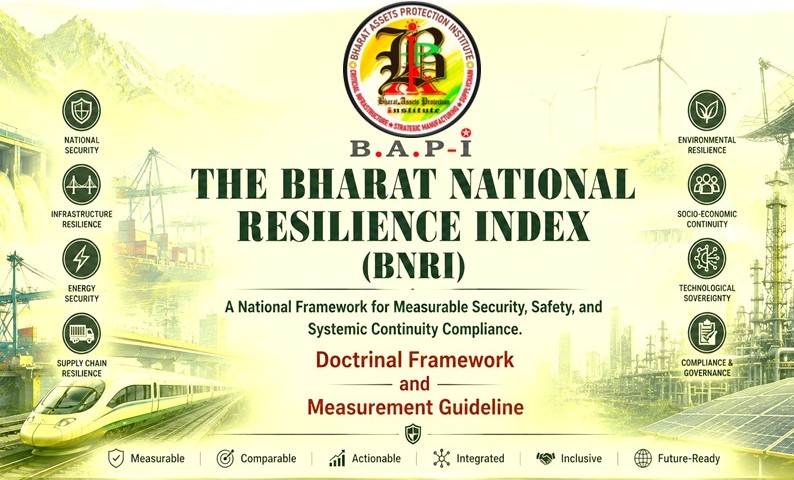
advisory; and compliance operates without statutory consequence. The Bharat National Resilience Index
(BNRI) is proposed as India's first statutory instrument to quantify
resilience as a measurable systems property. It converts resilience from a
policy aspiration into a graded, penalised, and incentivised obligation of
governance. BNRI integrates threat assessment, zero-tolerance compliance,
adaptive governance, defence-in-depth engineering, and all-hazards
consequence mapping within a single national framework anchored in the
proposed Critical Infrastructure Protection Act (CIPA). |
Keywords : Critical Infrastructure Protection, Bharat National Resilience Index, Bharat National Resilience Ecosystem, CIPA, BIPCARD, SOMA, RAS, Prahari, Cyber-Physical Systems, Adaptive Risk Governance, Defence-in-Depth, Zero-Tolerance Compliance, Continuity Modelling, All-Hazards Framework, Legal and Regulatory Harmonisation.
|
The framework operates through three
interlocking matrices. At the macro level, a 6×4 Operational Domain Matrix
maps six national domains (Critical Infrastructure, Strategic Manufacturing,
Supply Chain, Technology Sovereignty, Comprehensive National Security, and
Global Engagement) against four cross-cutting measurement parameters. At the
analytical level, a 10×7 Framework Matrix applies ten foundational dimensions
drawn from tested global CIP practices and reinterprets them through seven
India-specific governance perspectives, yielding 70 analytical intersections.
At the sectoral level, the BAP-I Twelve-Cluster Securitisation Model
classifies over 150 standalone sectors into operationally distinct domains,
each scored against the BNRI Scale (Class I through Class V). |
|
|
BNRI is operationalised within the
Bharat National Resilience Ecosystem (BNRE), a seven-component institutional
architecture comprising BIP-CARE (legislative foundation), BIP-CARP
(implementation programme), BIPCARD (apex governance directorate under the
National Security Council), SOMA (multi-stakeholder coordination), RAS
(independent audit and scoring bureau), Prahari (dedicated multi-domain
operational force), and the BNRI measurement instrument itself. A closed
governance loop governs the system: BIPCARD sets standards; Prahari
implements; RAS audits and scores; findings feed back to BIPCARD for policy revision;
SOMA coordinates all stakeholders. |
|
|
The document presents the full
doctrinal architecture, including the BNRI computation model (Rc = f(P, M,
Ra, Rr); BNRI_Score with compliance gate, cascade-exposure penalty, and
criticality uplift modifiers), four core measurement pillars weighted at 30/25/25/20,
a tiered regulatory framework (Tier-A/B/C with proportional audit density),
penalty-incentive mechanisms linked to Resilience Credits and procurement
eligibility, and a National Resilience Data Grid for real-time data fusion
and early-warning intelligence. Appendix A provides the mathematical
derivation and justification for every formula, index, and weighting
structure. Appendix B catalogues all proposed bodies, acts, authorities,
indexes, programmes, reports, certifications, and fiscal instruments within
the BNRE architecture. This is not a theoretical exercise.
BNRI is conceived as a working doctrinal instrument for statutory adoption; a
measurement guideline that positions critical infrastructure protection and
sectoral resilience as the third pillar of India's comprehensive national
security, alongside territorial defence and diplomatic security. It
establishes India's indigenous capacity for resilience quantification,
positioning the country as a standard-maker rather than a standards-taker in
resilience governance for the Global South. For details – Download PDF |
|